
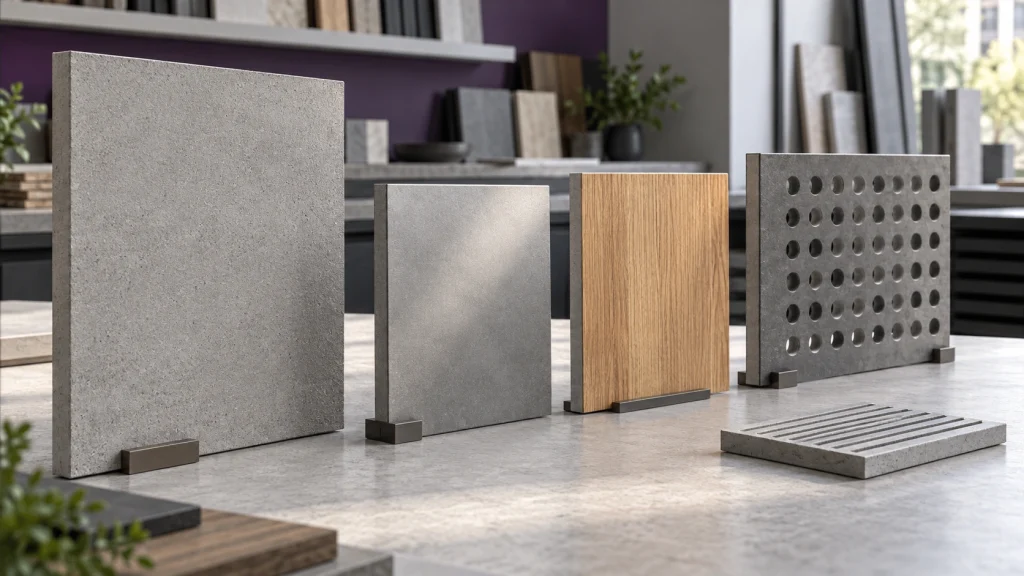
Fiber cement board is commonly specified for wall linings, backer boards and floor substrates. For fabricators and panel manufacturers, however, the sheet can also be the starting material for a different finished product.
DART fiber cement boards can be specified for sanding, polishing, facing and further processing. These routes create opportunities to develop decorative panels, prefabricated components and layers within composite systems.
The key is to select the board for what it will become. A sheet intended for bonding to a facing may need a different surface condition from one intended to remain visible.
Sanding and Polishing Serve Different Purposes
Sanding can be used to prepare a controlled surface for subsequent processing. Depending on the equipment and specification, it may also help calibrate thickness. These are separate objectives: a smooth-looking board does not automatically meet a tight thickness tolerance.
For lamination, the useful characteristics include sound surface integrity, suitable texture, cleanliness and a moisture condition compatible with the adhesive process. Removing dust is essential before bonding.
Polishing is more closely associated with refining the visible surface. On a suitable board, it can develop a smoother mineral appearance for exposed decorative use. The achievable finish depends on the board formulation, texture and processing sequence.
A polished board should be approved against a physical sample. It should not automatically be described as mirror-finished, stain-resistant or waterproof. A compatible sealer or protective coating may be needed for the intended exposure.
The best bonding surface is not necessarily the glossiest surface. Agree on the surface preparation with the adhesive or coating supplier and validate it using the actual board.
1. Decorative Laminated Panels
A fiber cement substrate can be evaluated for combination with HPL, wood veneer, decorative films or other selected facings.
This creates opportunities for interior panel manufacturers serving hotel interiors, reception areas, offices, retail spaces and residential fit-outs. The facing provides the chosen appearance, while the board forms the underlying mineral substrate.
Different finishes require different processes. HPL bonding, veneer pressing and film lamination should each be assessed for adhesive compatibility, pressure, temperature and board conditioning.
A one-sided finish can also introduce an unbalanced build-up. Assess panel bowing and determine whether a balancing layer is needed. Edge appearance, sealing and corner details should be part of the prototype, rather than decisions left until installation.
2. Coated, Printed and Exposed Mineral Panels
Further processing can make the board itself part of the visual design.
Potential routes include compatible factory coatings, printed decorative finishes and sanded or polished mineral surfaces. These allow fabricators to explore colours, patterns and textures for interior features and selected architectural components.
For example, a retail display may call for a consistent printed finish, while a reception-desk facing may favour the natural variation of a refined cement surface.
Assess the finish against its actual use: cleaning, abrasion, staining, sunlight and moisture exposure may all matter. An interior coating should not be assumed suitable for an exterior panel, and an existing factory-finished facade board should not be sanded without approval.
3. Facings and Layers in Composite Panels
Fiber cement can also be considered as a facing or intermediate layer in a multilayer panel. Possible development routes include insulated sandwich panels, lightweight-core composites and backing layers for selected decorative surfaces.
In these products, the board contributes one part of the construction. The core, adhesive, opposing facing, edges and connections determine how the finished panel behaves.
A mineral facing does not make every composite non-combustible, and bonding two boards to insulation does not automatically create a structural panel. Fire, load, bond-durability and exposure requirements must be assessed for the proposed build-up.
For system manufacturers, the practical opportunity is to define the board’s role clearly—such as a surface layer, backing layer or load-distributing layer—and then select and test it accordingly.
4. Prefabricated Interior Components
Cutting, drilling, edge processing and controlled surface preparation can turn sheets into components prepared for assembly.
Development opportunities include panel inserts for framed partitions, access-panel infills, modular interior linings and cladding components for reception counters or display units.
The benefit is the potential to complete repeatable processing in the workshop, where dimensions, finishes and interfaces can be checked before delivery.
These applications still require attention to support and attachment. A thin panel used as a cabinet or counter facing should not be assumed capable of supporting hinges, concentrated loads or an unsupported worktop.
5. Perforated and Profiled Architectural Panels
Suitable fiber cement boards can be assessed for perforation, routing or shallow profiling to create decorative screens and patterned surfaces. Some configurations may also become facings in acoustic assemblies.
Machining removes material, so the remaining section, hole spacing, edge distances and fastening positions need review. Deep grooves or dense perforations can change the panel’s strength and handling characteristics.
For acoustic products, evaluate the complete arrangement of openings, backing and cavity. A perforated board alone does not establish a sound-absorption rating.
Match the Processing Route to the Market
| Processing route | Product to develop | Potential customers |
|---|---|---|
| Surface sanding and thickness calibration | Substrates prepared for an agreed bonding process | Laminators and decorative-panel manufacturers |
| Polishing with an appropriate protective finish | Exposed mineral-look components | Interior fabricators and architectural-product makers |
| Lamination or coating | Finished decorative panels | Commercial fit-out suppliers and panel processors |
| Bonding to a selected core | Composite-panel facings or intermediate layers | Sandwich-panel and modular-system manufacturers |
| Cutting, drilling and edge processing | Components prepared for assembly | Prefabrication businesses and partition-system suppliers |
| Perforation or profiling | Patterned panels and acoustic-facing components | Architectural-panel and acoustic-system developers |
These are development directions, not interchangeable applications for every board grade.
What to Agree Before Production
A useful processing specification should define:
- The final application and whether the board will remain visible.
- Finished thickness, dimensional tolerances, flatness and edge quality.
- The surface condition on each side, including any sanding or polishing.
- The facing, coating, adhesive or core to be used.
- Moisture conditioning, pressing and curing requirements.
- Performance checks for the finished component or assembly.
Start with small process trials, then evaluate representative full-size panels. Small bonded samples may not reveal full-panel bowing, handling damage or dimensional movement. Check samples after relevant conditioning, not only immediately after production.
Fiber cement machining also requires suitable dust controls. Review the board’s safety data and establish appropriate extraction, work practices and protective measures for the operation. OSHA’s fiber-cement cutting guidance explains the importance of controlling respirable silica dust during relevant cutting operations. osha.gov
Discuss the Finished Product with DART
A productive enquiry starts with the product you want to manufacture, not only the sheet dimensions.
Share your intended application, drawings, finished thickness, surface requirements and proposed facing or core. For Dartex fiber cement boards, this information helps DART discuss an appropriate substrate specification and sample-processing plan.
From sanded substrates to decorative components and composite-panel layers, further processing gives fiber cement a wider role in manufacturing. Matching the board to the process is what turns that potential into a workable product.