
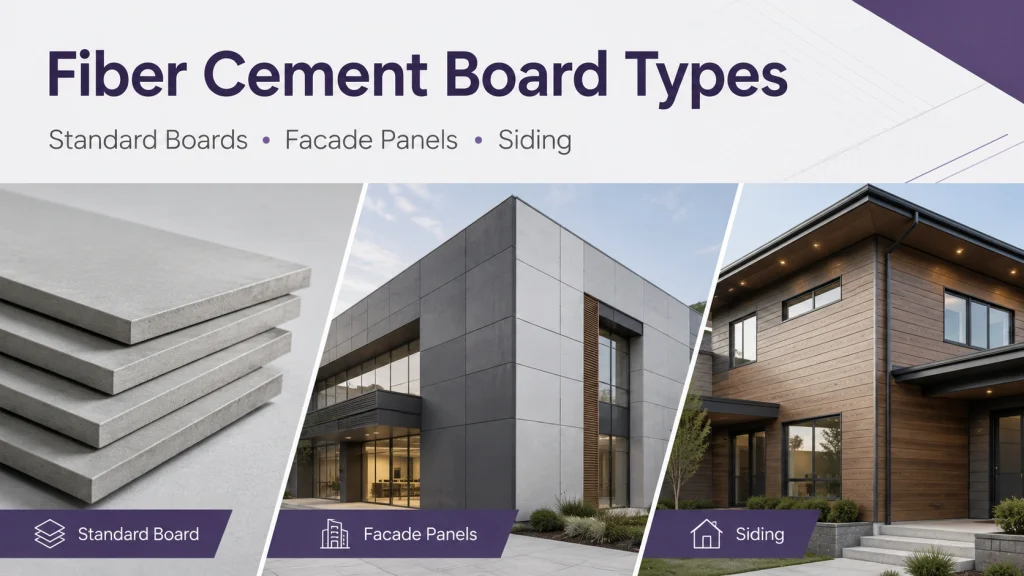
Fiber cement is used across a wide range of modern construction projects, from interior wall linings and soffits to ventilated facades and residential siding.
However, the term fiber cement board covers several products with very different forms, surface treatments and installation methods. A standard construction board is not the same product as an architectural facade panel, while fiber cement siding is designed around a different building style and installation system.
Understanding these differences is important for distributors, contractors and project buyers. Choosing the wrong product can create unnecessary costs, unsuitable finishes or installation difficulties.
This guide explains the main fiber cement board types, their typical applications and the factors that should be considered before selecting a product.
What Is Fiber Cement Board?
Fiber cement is a cement-based composite material reinforced with fibers. Depending on the manufacturer and product type, the formulation may include cement, cellulose or other reinforcing fibers, mineral fillers, water and selected additives.
The exact formulation and manufacturing process vary between producers. Density, pressing pressure, curing method, surface treatment and reinforcement all influence the final board’s strength, appearance and intended use.
In European markets, EN 12467 is an important standard for fiber cement flat sheets. It establishes technical requirements, inspection methods, testing procedures and acceptance conditions for fiber cement flat sheets, siding shingles and planks intended for internal or external wall and ceiling finishes.
The presence of the words “fiber cement” in a product name does not automatically mean that every board has the same:
- Density
- Flexural strength
- Fire classification
- Moisture movement
- Freeze-thaw performance
- Surface durability
- Intended application
Technical data and test reports should therefore be reviewed for the exact product being considered.
Why Is Fiber Cement Used in Construction?
Fiber cement combines mineral-based durability with the ability to be produced in different thicknesses, dimensions, profiles, colors and textures.
Depending on the product specification, fiber cement materials may offer:
- Good dimensional stability
- Resistance to moisture and weather exposure
- Low susceptibility to rot and insect damage
- Suitable fire performance
- Long service life
- Relatively low maintenance
- Multiple surface and color options
- Compatibility with different wall and facade systems
Fiber cement is used for facades, roofing, interior wall cladding, soffits, exterior construction elements and other architectural applications.
These benefits should still be described carefully. For example, fiber cement products are often moisture-resistant, but that does not mean every board should be described as completely waterproof.
The final performance of a wall or facade also depends on:
- Joint design
- Fasteners
- Substructure
- Flashing
- Waterproof membranes
- Ventilation cavities
- Surface coatings
- Edge treatment
- Installation quality
Fiber cement should therefore be selected as part of a complete construction system rather than treated as an isolated sheet material.
1. Standard Fiber Cement Board
Standard fiber cement board is generally supplied as a flat, unfinished or sanded construction sheet.
It is normally selected for its mechanical and practical building performance rather than for its decorative appearance. The surface can remain visible in some utility applications, but it is more commonly covered, painted, tiled or incorporated into a wider wall system.
Typical applications
Standard fiber cement boards may be used for:
- Interior wall lining
- Partition systems
- Ceiling applications
- Exterior wall substrates
- Soffits and fascia
- Utility areas
- Modular and prefabricated buildings
- General-purpose backing boards
The suitability of a specific board for each application must be confirmed through its technical data, classification and installation instructions.
For example, an interior lining board may not have the same weather-resistance requirements as an exterior sheathing board. A board intended for ceilings may also use a different thickness from one designed for impact-prone wall areas.
Main characteristics
Standard fiber cement board usually has:
- A plain grey or light cement-colored surface
- Square or tapered edges
- Large sheet dimensions
- Several available thicknesses
- A smooth, lightly textured or sanded finish
It is often the most practical choice when the board will function as a construction layer rather than the final architectural surface.
When should it be selected?
Standard fiber cement board is appropriate when the project needs:
- A stable mineral-based construction sheet
- A substrate for another finish
- An interior or exterior backing layer
- A board that can be cut and installed using conventional construction methods
- Flexible dimensions and thicknesses
It should not automatically be treated as a substitute for a finished facade panel. The two products may look similar in sample size, but their surfaces, edge treatments, tolerances and long-term appearance can be very different.
2. Fiber Cement Facade Panels
Fiber cement facade panels are designed to form part of the visible exterior surface of a building.
Compared with general-purpose boards, facade panels place greater emphasis on:
- Architectural appearance
- Surface consistency
- Color
- Panel layout
- Joint design
- Exterior durability
- Fixing methods
- Long-term visual performance
Large-format fiber cement panels are commonly installed on commercial buildings, apartments, schools, public buildings and modern residential projects.
Many architectural fiber cement panels are used in ventilated rainscreen facade systems. In this type of construction, the panels are fixed to a supporting substructure with a ventilated cavity behind the exterior surface. The cavity supports drainage and airflow and helps the wall assembly manage moisture.
Facade panels can be installed using visible screws or rivets, or with concealed rear-fixing systems, depending on the panel, substructure and project design.
Pre-Finished Fiber Cement Facade Panels
Pre-finished panels have a factory-applied surface coating or decorative finish.
They may be produced in:
- Solid colors
- Matt finishes
- Smooth finishes
- Textured coatings
- Metallic or special-effect finishes
- Custom project colors
Factory finishing provides a controlled appearance before the panels arrive on site. It can also reduce the need for site painting and help maintain greater consistency across a facade.
Pre-finished panels are commonly selected for:
- Commercial buildings
- Educational facilities
- Public buildings
- Feature walls
- Mixed-color facade designs
- Branded architectural projects
When comparing pre-finished panels, buyers should review more than the initial color. Coating adhesion, UV exposure, gloss level, edge treatment and long-term color behavior may also influence the project result.
Through-Colored Fiber Cement Facade Panels
Through-colored fiber cement panels contain color throughout the board body rather than relying only on a surface paint layer.
This creates a more natural and material-focused appearance. Cut edges can remain visible as part of the architectural design, and minor surface variations often contribute to the panel’s character.
Through-colored materials are commonly associated with:
- Natural cement textures
- Matt surfaces
- Exposed panel edges
- Open-joint facades
- Modern architectural projects
- Neutral and mineral-inspired colors
EQUITONE, for example, describes many of its facade materials as through-colored and emphasizes their raw fiber cement character.
Through-colored does not necessarily mean that the surface and internal core are visually identical in every respect. Surface treatments, sanding, translucent coatings and production processes may still affect the final appearance.
Samples should therefore be approved before project production.
Textured and Grooved Fiber Cement Panels
Textured and grooved panels add depth to a facade through surface machining, embossing, linear patterns or decorative finishing.
Available effects may include:
- Linear grooves
- Vertical or horizontal channels
- Ribbed surfaces
- Concrete-inspired textures
- Wood-inspired textures
- Printed patterns
- Custom CNC machining
- Perforated designs
Grooved surfaces interact with daylight and create changing shadow lines across the building. Swisspearl’s Gravial panel, for example, uses linear milling to produce a distinct light-and-shadow effect.
Some architectural fiber cement panels can also be cut, milled, perforated or printed to create customized facade layouts.
Textured panels work well for entrances, feature elevations and projects that need a stronger visual identity. However, machining depth, fixing position and remaining panel thickness must be properly controlled.
3. Fiber Cement Siding
Fiber cement siding is normally supplied as long, relatively narrow planks rather than large rectangular facade sheets.
It is especially common in:
- Detached houses
- Villas
- Timber-frame buildings
- Light-gauge steel buildings
- Low-rise apartments
- Residential renovation
- Small commercial buildings
Fiber cement siding is valued for combining the visual language of traditional siding with the durability and lower maintenance requirements of a cement-based material.
James Hardie describes fiber cement siding as a durable, long-lasting and low-maintenance product used on residential houses and some commercial buildings.
Common siding appearances
Fiber cement siding can be supplied with:
- Wood grain texture
- Smooth surface
- Painted finish
- Natural or neutral colors
- Horizontal lap profiles
- Shiplap profiles
- Vertical board-and-batten layouts
Wood grain fiber cement siding is designed to reproduce the appearance of timber while reducing problems associated with natural wood, such as rot, pest damage and frequent repainting.
How is siding different from facade panels?
The main difference is not simply the material formulation. It is the product format and installation approach.
| Feature | Fiber Cement Facade Panels | Fiber Cement Siding |
|---|---|---|
| Product form | Large rectangular panels | Long, narrow planks |
| Typical appearance | Modern panelized facade | Horizontal or vertical siding |
| Common buildings | Commercial and public projects | Residential and low-rise buildings |
| Joint design | Open or defined panel joints | Lap, shiplap or plank joints |
| Fixing system | Rivets, screws or concealed fixing | Nails, screws or siding clips |
| Design emphasis | Panel layout and architectural surface | Repeated lines and residential appearance |
A large facade panel can sometimes be cut into strips, but this does not automatically turn it into a complete siding product. Purpose-made siding may include specific profiles, edge designs, coating systems and installation requirements.
Fiber Cement Product Comparison
| Product Type | Typical Form | Surface | Main Applications |
|---|---|---|---|
| Standard Fiber Cement Board | Large flat sheet | Plain, smooth or sanded | Walls, ceilings, substrates and soffits |
| Pre-Finished Facade Panel | Large architectural panel | Factory-coated | Commercial and public building facades |
| Through-Colored Facade Panel | Large architectural panel | Natural matt finish | Ventilated facades and premium architectural projects |
| Textured or Grooved Panel | Large decorative panel | Milled, grooved or textured | Feature facades and customized elevations |
| Fiber Cement Siding | Long narrow plank | Wood grain or smooth | Residential and low-rise exterior walls |
How to Choose the Right Fiber Cement Product
There is no single fiber cement board suitable for every project.
Before requesting a quotation, buyers should clarify the following points.
1. Is the board a substrate or the final finish?
A board that will be covered with tiles, render or another decorative layer may not need an architectural surface.
A visible facade panel requires greater attention to color, texture, coating and joint layout.
2. Is the application internal or external?
Exterior products must be selected according to the expected weather exposure and local climate.
Rain, humidity, temperature changes, freeze-thaw cycles, sunlight and wind pressure may all affect product selection.
3. Is the project using large panels or siding planks?
Large panels suit modern, modular facade layouts.
Siding planks create repeated horizontal or vertical lines and are often more familiar in residential construction.
4. What technical performance is required?
Confirm the required:
- Board thickness
- Density
- Flexural strength
- Fire classification
- Moisture movement
- Water absorption
- Freeze-thaw performance
- Impact performance
- Dimensional tolerances
Do not assume that one test report applies to every thickness, color or product configuration.
5. What installation system will be used?
The board must be compatible with the selected:
- Timber or metal framing
- Ventilated facade substructure
- Screw or rivet system
- Concealed fixing system
- Joint width
- Expansion allowance
- Waterproofing and flashing details
The substructure and fixing method should be considered before the final board dimensions are confirmed.
6. What surface appearance is expected?
For architectural panels, request physical samples before production.
Digital images cannot fully show:
- Surface texture
- Natural color variation
- Gloss level
- Edge appearance
- Light reflection
- Groove depth
For large projects, an approved sample or project mock-up can reduce misunderstandings.
Final Thoughts
Fiber cement is not one single product.
Standard boards, pre-finished facade panels, through-colored materials, textured panels and siding planks are designed for different applications and visual requirements.
The correct selection begins by identifying whether the project requires:
- A construction substrate
- A finished architectural facade
- A natural through-colored panel
- A decorative textured surface
- A residential siding product
Once the intended application is clear, technical data, test reports, dimensions, finishes and fixing methods can be reviewed more effectively.
A well-selected fiber cement product does more than meet a specification. It supports easier installation, more predictable performance and a finished building that looks appropriate for its market and environment.
Need Help Selecting the Right Fiber Cement Board?
Tell us the application, required dimensions, surface finish, quantity and destination market. Our team will help you compare suitable standard boards, facade panels and siding products.