
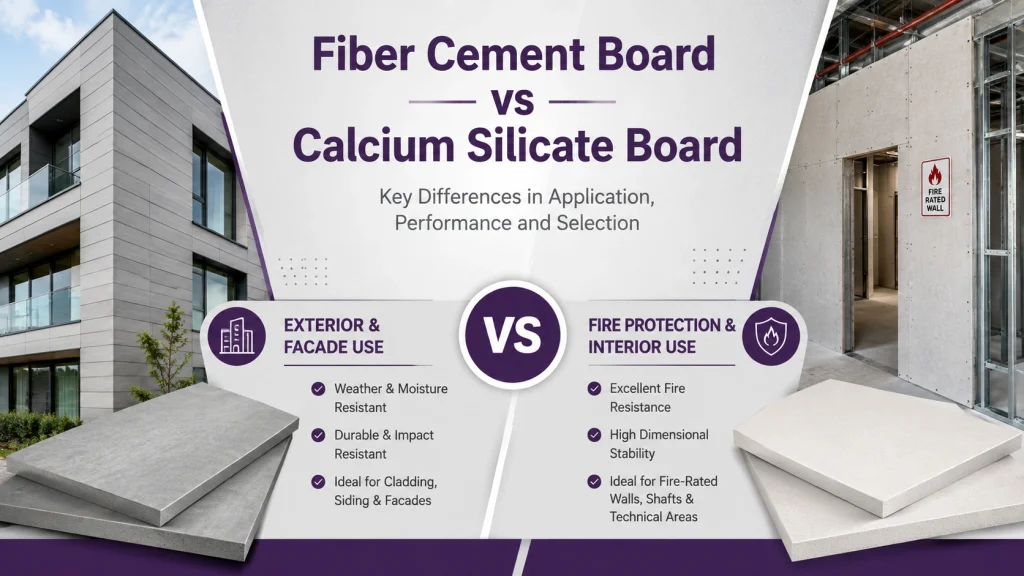
Fiber cement board and calcium silicate board are often placed in the same category by building-material buyers.
Both are mineral-based sheet materials. Both can be used in wall and ceiling systems. Both may offer good moisture and fire performance depending on the product.
That similarity, however, often leads to the wrong conclusion:
Fiber cement board and calcium silicate board are not simply two names for the same material.
They are different product families, and their intended applications can be very different.
A fiber cement board designed for exterior cladding, for example, should not automatically be replaced by a calcium silicate fire-protection board of the same thickness. Likewise, a general-purpose fiber cement sheet should not automatically be specified for a tested passive-fire-protection system.
The correct choice depends on what the board is expected to do in the building.
This guide explains the differences in composition, density, strength, fire performance, moisture behavior, exterior use, thermal properties, installation and cost — and, most importantly, how to choose the right board for a real project.
Quick Answer
The simplest way to understand the difference is:
Fiber cement board is generally developed as a durable construction, lining, siding or facade material.
Calcium silicate board is a broader mineral-board category, with many products specifically engineered for passive fire protection, high-temperature insulation or specialist interior applications.
Fiber cement products covered by EN 12467 include flat sheets, siding shingles and planks intended for internal and external wall and ceiling finishes. The standard specifically notes that it does not cover sheets whose purpose is fire protection.
Calcium silicate boards, meanwhile, vary significantly by product. Promat, for example, offers calcium silicate boards specifically designed for passive fire protection of structures, compartmentation and service enclosures.
So the question should not be:
Which material is better?
It should be:
Which board is designed and tested for my application?
Fiber Cement Board vs Calcium Silicate Board at a Glance
| Factor | Fiber Cement Board | Calcium Silicate Board |
|---|---|---|
| Basic material concept | Cement-based composite reinforced with fibers | Calcium-silicate-based mineral matrix, often reinforced with fibers and fillers |
| Typical product roles | Building boards, wall lining, ceilings, soffits, siding, facade panels | Fire protection, compartmentation, high-temperature protection, specialist lining |
| Exterior facade products | Widely available | Product-dependent; not all calcium silicate boards are intended for full exterior exposure |
| Siding products | Widely available | Uncommon |
| Decorative facade finishes | Pre-finished, through-colored, textured and grooved options available | Usually not the primary product focus |
| Density | Product-dependent; many facade/building boards are relatively dense | Very wide range depending on fire, insulation and construction requirements |
| Mechanical performance | Often selected where surface hardness, impact resistance and facade durability matter | Varies substantially; some high-density boards are strong and self-supporting |
| Fire performance | Product-specific; classifications vary | Many specialist products are designed specifically for passive fire protection |
| Thermal insulation | Usually not the main function | Often a significant advantage of specialist calcium silicate products |
| Moisture performance | Exterior-grade products can be designed for demanding weather exposure | Some products tolerate high humidity; exterior exposure must be checked product by product |
| Main selection standard | EN 12467 commonly relevant to fiber cement flat sheets in Europe | Usually application- and system-specific fire or construction documentation |
| Best choice depends on | Application, exposure, finish, strength and fixing system | Fire rating, temperature, humidity, assembly design and intended use |
Important: This table describes general market tendencies. Neither material family has one universal density, fire rating, strength or moisture performance.
1. What Is Fiber Cement Board?
Fiber cement is a cement-based composite reinforced with fibers.
A typical formulation may contain:
- Cement
- Silica or mineral fillers
- Cellulose fibers
- Synthetic reinforcing fibers
- Water
- Pigments or functional additives
The exact formulation varies by manufacturer and product.
Swisspearl, for example, describes the main components of its fiber cement as cement, fillers, cellulose, synthetic fibers, pigments and water. James Hardie similarly identifies Portland cement, sand, water and cellulose fibers as core ingredients in its fiber cement products.
The board is engineered not only through its ingredients but also through:
- Fiber distribution
- Sheet-forming method
- Pressing
- Curing
- Density control
- Surface treatment
- Coating
- Machining
This is why two fiber cement boards of identical thickness can have very different performance.
Typical fiber cement product families
Fiber cement can be manufactured as:
Standard Fiber Cement Board
Used for walls, ceilings, soffits, substrates and general construction.
Fiber Cement Facade Panels
Large-format architectural panels used as visible exterior cladding.
These may include:
- Pre-finished panels
- Through-colored panels
- Textured panels
- Grooved panels
Fiber Cement Siding
Long plank-format products used primarily for residential and low-rise exterior walls.
Fiber cement therefore extends from basic construction sheets to finished architectural materials.
2. What Is Calcium Silicate Board?
The name calcium silicate board also covers more than one type of product.
A calcium silicate board can be based on a calcium silicate mineral matrix combined with cement, mineral fillers and reinforcing fibers. Formulations and manufacturing processes vary according to intended performance.
For example, PROMATECT-H is described as a calcium silicate mineral board reinforced with selected fibers and fillers and designed as a fire-protective construction board.
Calcium silicate materials are commonly engineered for functions such as:
- Passive fire protection
- Structural steel protection
- Concrete protection
- Fire-rated partitions
- Fire-resistant duct systems
- Service enclosures
- High-temperature insulation
- Specialist industrial applications
This is an important difference.
When a supplier says:
Calcium silicate board
you should immediately ask:
Which type of calcium silicate board, and what is its tested intended use?
A lightweight thermal-insulation calcium silicate board and a high-density fire-protection board are not interchangeable simply because both are called calcium silicate.
3. Composition: The Names Tell Only Part of the Story
The biggest mistake buyers make is comparing product names instead of product specifications.
Fiber cement emphasizes a cementitious matrix reinforced by fibers.
Calcium silicate boards emphasize a calcium-silicate mineral structure, often engineered around fire, thermal or moisture-management performance.
But both material families may contain:
- Cementitious binders
- Mineral fillers
- Reinforcing fibers
- Functional additives
So composition alone does not tell you which board is stronger, lighter or more durable.
The manufacturing process matters just as much.
For fiber cement, layered sheet formation, pressing and curing affect strength, density and dimensional stability. Swisspearl describes a layered manufacturing process in which thin slurry layers are progressively built up until the required panel thickness is achieved.
For a buyer, the important lesson is simple:
Do not approve a building board based only on its material name.
Always compare the technical data sheet.
4. Density and Weight: Which Board Is Lighter?
There is no universal answer.
Some calcium silicate boards are significantly lighter than dense fiber cement facade boards, while other calcium silicate products are designed at higher densities for demanding fire-protection applications.
Fiber cement also varies substantially.
For example, one Swisspearl construction fiber cement board has an average dry density of approximately 1,800 kg/m³, while its siding products have an average dry density around 1,340 kg/m³.
By comparison, PROMATECT-H, a specialist calcium silicate fire-protection board, lists an average nominal dry density of approximately 975 kg/m³.
These are product examples, not category averages.
They demonstrate why statements such as:
“Calcium silicate board is always lighter.”
or:
“Fiber cement board is always denser.”
are too simplistic.
Why density matters
Density affects:
- Board weight
- Handling
- Container loading
- Impact resistance
- Fastener behavior
- Surface hardness
- Thermal performance
- Cutting
- Installation speed
When comparing quotations, request both:
Density in kg/m³
and
Weight in kg/m²
A price comparison without density and weight can easily become a comparison between two completely different specifications.
5. Strength and Impact Resistance
For standard construction, facade and siding applications, fiber cement is often selected because it combines a hard cementitious surface with fiber reinforcement.
High-density fiber cement products can provide strong bending performance and good impact resistance for demanding walls and exterior cladding.
For example, the Swisspearl Construction technical sheet lists bending strength values under EN 12467 and identifies the product for both building-board and ventilated-facade applications.
But this does not mean fiber cement is automatically stronger than every calcium silicate board.
Some calcium silicate fire boards are engineered as rigid, self-supporting construction materials. Promat specifically describes certain calcium silicate products as suitable for self-supporting fire-protection constructions.
Therefore, asking:
Fiber cement or calcium silicate — which is stronger?
is not enough.
Ask instead:
- What is the bending strength?
- Is the value tested dry or wet?
- What board thickness was tested?
- What is the density?
- What span is allowed?
- What support spacing is required?
- Is the board intended to carry loads?
- Is impact resistance relevant?
- Is the product structural or non-structural?
The numbers matter more than the product name.
6. Fire Performance: This Is Where the Difference Becomes Important
This is one of the most important areas where buyers should avoid generalization.
Fiber cement board
Fiber cement is mineral-based and can provide strong reaction-to-fire performance.
However, the exact classification depends on:
- Board formulation
- Surface coating
- Thickness
- Mounting condition
- Test method
- Complete wall or facade system
Not every fiber cement board has the same fire classification.
For example, current Swisspearl products show different documented reaction-to-fire classifications depending on the specific board and installation configuration.
Calcium silicate board
Many calcium silicate products are developed specifically for passive fire protection.
PROMATECT-H, for example, is classified A1 under EN 13501-1 in its documented application and is used in tested fire-protection assemblies.
Other calcium silicate systems are designed to protect:
- Steel columns and beams
- Concrete structures
- Ductwork
- Fire compartments
- Service shafts
for specified periods under tested assemblies.
Reaction to fire is not the same as fire resistance
This distinction is critical.
Reaction to fire describes how the material contributes to fire.
Fire resistance describes how a complete building element — such as a wall, ceiling, duct enclosure or structural protection system — performs during a fire for a specified period.
A board being A1 or A2 does not automatically mean:
“This wall is 120-minute fire rated.”
The complete tested system matters.
7. EN 12467: An Important Difference for Buyers
For European fiber cement products, EN 12467 is an important reference.
The standard covers fiber cement flat sheets, siding shingles and planks intended for internal and external wall and ceiling finishes. It includes product requirements and test methods.
But there is an important sentence in the scope:
EN 12467 does not cover sheets intended specifically for fire-protection purposes.
This helps explain why comparing a fiber cement facade sheet with a calcium silicate fire-protection board purely through EN 12467 can be misleading.
If a buyer requests:
“Calcium silicate board according to EN 12467”
the first step should be to clarify the intended application.
The buyer may actually need:
- Fiber cement exterior board
- Calcium silicate fire board
- General mineral construction board
- Cement backer board
- High-temperature insulation board
The specification should follow the function.
8. Moisture and Humidity Resistance
Both materials can perform well in humid environments — but again, the exact board matters.
Fiber cement
Exterior-grade fiber cement products can be engineered for:
- Rain exposure
- Humidity
- Wet-dry cycling
- Freeze-thaw conditions
- Exterior facade applications
EN 12467 includes durability-related testing relevant to fiber cement products intended for exterior exposure. Individual products should still be checked for their specific category, class and intended use.
Fiber cement should generally be described as:
- Moisture resistant
- Weather resistant
- Durable under specified exposure
rather than automatically calling every board waterproof.
Calcium silicate
Some calcium silicate fire-protection boards also perform well in humid conditions.
PROMATECT-H, for example, is documented for internal use, high-humidity internal use and certain semi-exposed exterior conditions. For fully exposed conditions, Promat advises consulting its technical department.
That sentence illustrates an important procurement principle:
Moisture resistance is not the same as approval for permanent exterior weather exposure.
Always check the use category.
9. Exterior Walls and Facades: Which One Should You Choose?
If the project requires a finished exterior facade, fiber cement is generally the more established product family.
Architectural fiber cement systems can provide:
- Large-format panels
- Through-colored surfaces
- Factory-applied coatings
- Grooved finishes
- Textured finishes
- Visible fixing
- Concealed fixing
- Open-joint rainscreen layouts
- Siding planks
Fiber cement is therefore commonly specified not only for performance but also for architectural appearance.
Calcium silicate boards are less commonly selected as decorative architectural facade products because many are primarily engineered around fire or thermal performance.
This does not mean calcium silicate can never be used externally.
It means:
Exterior suitability must be confirmed for the exact calcium silicate product and assembly.
For a visible ventilated facade, ask specifically for a tested facade panel — not simply a “water-resistant mineral board.”
10. Interior Walls: The Choice Becomes More Application-Specific
For interior construction, both materials can be relevant.
Fiber cement may be suitable when you need:
- Durable wall lining
- Impact-resistant surfaces
- Wet-area substrates
- Commercial wall systems
- Modular construction
- Ceiling systems
- Hard-wearing utility areas
Calcium silicate may be particularly suitable when you need:
- Passive fire protection
- Fire-rated compartmentation
- Structural fire protection
- High-temperature performance
- Specialist humid-area performance
- Fire-protected service enclosures
The project specification should determine the material — not habit.
11. Thermal Insulation: Calcium Silicate Often Has an Advantage
Standard fiber cement board should not normally be treated as thermal insulation.
It is primarily a construction or cladding material.
Calcium silicate, by contrast, includes product families specifically developed for thermal protection and high-temperature insulation. Skamol and Promat both manufacture calcium silicate materials for thermal and fire-protection applications.
As a product-specific illustration, Swisspearl Construction lists a thermal conductivity of approximately 0.48 W/(m·K) for one 8 mm fiber cement board, while the cited PROMATECT-H documentation lists approximately 0.242 W/(m·K).
Again, these are individual products rather than universal category values.
The takeaway is:
If thermal insulation is a primary design requirement, compare λ-values directly rather than assuming that all mineral boards perform similarly.
12. Surface Finish and Architectural Appearance
This is one of fiber cement’s clearest advantages when the board remains visible.
Fiber cement facade products can be supplied with:
- Natural cement surfaces
- Through-colored cores
- Painted finishes
- UV-resistant coatings
- Matt finishes
- Wood grain textures
- Linear grooves
- Milled patterns
- Custom colors
The board therefore becomes part of the architectural design.
Calcium silicate fire boards are usually optimized first for technical performance rather than facade aesthetics.
Many can be:
- Painted
- Tiled
- Wallpapered
- Covered with another finish
but that is different from being designed as a finished architectural facade panel.
If appearance is a major part of the specification, this distinction matters.
13. Cutting and Installation
Both materials can generally be cut and mechanically fixed using appropriate tools, but installation recommendations vary widely.
For either material, confirm:
- Cutting method
- Dust-control requirements
- Fastener type
- Screw length
- Edge distance
- Framing spacing
- Joint treatment
- Board orientation
- Expansion or movement requirements
- Surface finishing
- Personal protective equipment
Never transfer installation instructions from one board to another simply because both are cementitious mineral sheets.
An 8 mm fiber cement facade panel and an 8 mm calcium silicate fire board may require completely different:
- Support systems
- Screw layouts
- Edge distances
- Joint details
- Finishing methods
Installation belongs to the system, not only to the board.
14. Which One Costs More?
There is no useful universal answer.
The price depends on:
- Density
- Thickness
- Board size
- Strength
- Raw-material formulation
- Fire classification
- Surface finish
- Coating
- Machining
- Certification
- Quantity
- Packaging
- Destination
A plain fiber cement construction board should not be compared directly with a specialist multi-hour calcium silicate fire-protection board.
Likewise, a premium through-colored architectural fiber cement facade panel should not be compared with a basic internal calcium silicate lining sheet.
A better comparison is:
Cost per required system performance
rather than:
Price per sheet
A higher-priced board may reduce:
- Layers
- Framing
- Finishing
- Maintenance
- Installation time
while a lower-cost board may be perfectly adequate when specialist performance is not required.
15. When Should You Choose Fiber Cement Board?
Fiber cement is usually worth considering when the project requires:
- General construction boards
- Interior wall lining
- Exterior substrates
- Ceilings
- Soffits
- Ventilated facade panels
- Finished architectural cladding
- Through-colored facades
- Textured or grooved facade panels
- Residential siding
- Wood grain exterior planks
- Modular-building boards
It is particularly strong when the project needs both technical durability and architectural appearance.
16. When Should You Choose Calcium Silicate Board?
Calcium silicate becomes especially relevant when the primary requirement is:
- Passive fire protection
- Structural steel protection
- Concrete fire protection
- Fire-rated service enclosures
- Fire compartmentation
- High-temperature insulation
- Industrial thermal applications
- Specialist moisture-management systems
But calcium silicate is a broad product family.
Always confirm the exact product type.
17. Five Common Buying Mistakes
Mistake 1: Treating the two names as interchangeable
They are not.
Ask for the composition, product family and intended use.
Mistake 2: Comparing thickness only
Two 10 mm boards can have completely different density, strength and fire performance.
Mistake 3: Assuming all mineral boards are waterproof
Moisture resistance, water impermeability and full exterior-weather exposure are different requirements.
Mistake 4: Assuming A1 means a complete fire-rated wall
Reaction-to-fire classification and system fire resistance are different.
Mistake 5: Comparing only FOB price per sheet
Compare performance, weight, installation, finishing, system cost and expected service conditions.
Practical Buyer Checklist
Before ordering either product, ask the supplier for:
Product information
- Exact product name
- Material type
- Density
- Thickness
- Board dimensions
- Weight per square metre
Mechanical performance
- Flexural strength
- Wet strength where relevant
- Impact performance
- Support-spacing requirements
Moisture performance
- Water absorption
- Moisture movement
- Wet-dry testing
- Exterior exposure classification
Fire performance
- Reaction-to-fire classification
- Test standard
- Fire-resistance system reports where required
Installation
- Fastener type
- Fastener spacing
- Edge distance
- Joint width
- Framing requirements
- Finishing instructions
Commercial requirements
- MOQ
- Packing
- Pallet weight
- Container loading quantity
- Surface options
- Custom dimensions
- Relevant certificates
The more complete the specification, the more meaningful the quotation comparison becomes.
Frequently Asked Questions
Is calcium silicate board the same as fiber cement board?
No.
Both are mineral-based construction boards, but their composition, manufacturing process, technical properties and intended applications can differ significantly.
Which board is stronger?
There is no universal answer.
High-density fiber cement boards can provide excellent bending and impact performance, while some calcium silicate fire-protection boards are engineered as strong, self-supporting systems.
Compare actual test data rather than material names.
Which board is better for exterior walls?
For visible architectural facades and siding, purpose-designed fiber cement products are widely available.
Some calcium silicate boards can tolerate humid or semi-exposed conditions, but full exterior suitability should always be confirmed in the product documentation.
Which board has better fire performance?
Specialist calcium silicate boards are widely used in passive fire-protection systems.
Fiber cement can also achieve excellent reaction-to-fire classifications, but the required fire performance must be checked for the exact board and complete assembly.
Can I replace calcium silicate board with fiber cement board in a fire-rated system?
Not automatically.
A tested fire-protection assembly should only use materials and configurations permitted by the relevant system documentation.
Changing the board may invalidate the tested fire rating.
Can calcium silicate board replace fiber cement facade panels?
Not automatically.
A board used as permanent exterior cladding must be suitable for the relevant weather exposure, fixing system, wind load, joint design and architectural requirements.
A fire-protection board of the same thickness is not necessarily a facade panel.
Final Thoughts
Fiber cement board and calcium silicate board are both valuable building materials.
But they solve different problems.
Fiber cement has developed into a broad construction and architectural material family covering standard boards, facade panels and siding.
Calcium silicate includes highly specialized products for passive fire protection, thermal insulation and demanding technical environments.
The best specification therefore starts with one question:
What does the board need to do in the building?
If the requirement is architectural cladding, exterior siding or a durable general-purpose construction board, a purpose-designed fiber cement product may be the logical starting point.
If the main requirement is structural fire protection, compartmentation or high-temperature insulation, a specialist calcium silicate system may be more appropriate.
Do not select either material based only on thickness, density, price or a single performance claim.
Compare:
Application → Technical Standard → Tested Performance → Installation System → Total Project Cost
That approach leads to better specifications, fewer installation problems and more reliable long-term performance.
Need Help Comparing Building Board Options?
If you are evaluating fiber cement board for a wall, ceiling, facade, siding or modular-building project, provide the application, required dimensions, surface finish, quantity and destination market.
A good product recommendation should begin with the project requirements — not simply with the board name.
More Knowledge
Continue exploring practical guidance on fiber cement board selection, performance, facade systems and construction applications.
ConstructMat Solutions
A reliable fiber cement board is only one part of the system. Explore fixing, joint treatment and waterproofing accessories selected for professional board installation.
Board Fixing Accessories
Screws, spacers, shims, washers and related accessories for accurate and stable fiber cement board installation.
Explore Fixing Solutions →Joint Treatment Accessories
Mesh tapes, joint tapes, corner reinforcement and related products for more controlled board joints and finishing.
Explore Joint Solutions →Waterproofing Accessories
Membranes, sealing tapes, collars and waterproofing components for wet areas and detailed board installations.
Explore Waterproofing →Combine fiber cement boards with appropriate fixing, joint treatment and waterproofing accessories for a more complete installation solution.
Need Help Selecting the Right Fiber Cement Solution?
Tell us the application, required dimensions, thickness, surface finish, quantity and destination market. We will help you compare suitable fiber cement boards, facade panels and siding products for your project.